
Quick answer: what to do if your trees are dying
If you are seeing red or fading crowns, standing dead trees, thinning tops, or clusters of trees dying together on a parcel in Sagle, Sandpoint, or anywhere in Bonner County, you are watching one of a handful of native insects and diseases doing what they have always done. A century of fire suppression, drought, and overstocked stands has pushed the pace of it much higher.
The forest does not fix itself once it gets to this stage, and every unhealthy year makes the next fire season worse. The two tools that do real work on a private parcel are forestry mulching to knock down understory and ladder fuels, and selective logging to remove the trees that are already gone and the ones that are feeding the next round of beetles.
If you want a straight answer on what is happening on your ground and what it will take to fix it, call 208-603-4777 or email info@premierlandservice.com. We will walk the property and put together a phased plan.
The trees that actually grow here
Before you can read a sick forest, you have to know what is supposed to be there. On the Bonner County side of the Panhandle, most private forest ground is some mix of these species. Idaho Department of Lands and the Idaho Panhandle National Forests both recognize this same species list for our habitat types.
- Douglas-fir (red fir locally). The most common tree in Idaho and the most common tree on most Sagle and Sandpoint parcels. Grows almost anywhere. Susceptible to Douglas-fir beetle in older, denser stands and to all three of the root diseases we deal with here.
- Grand fir (white fir locally). Shade-tolerant, moves in under other trees, and has climbed to a huge share of standing volume across northern Idaho over the last century. It is one of the most root-disease-susceptible species we have and the most common target of fir engraver beetle. On the ground in Bonner County right now, grand fir is dying at a pace you can see from the road. If a stand is losing trees this year, grand fir is usually the first one going.
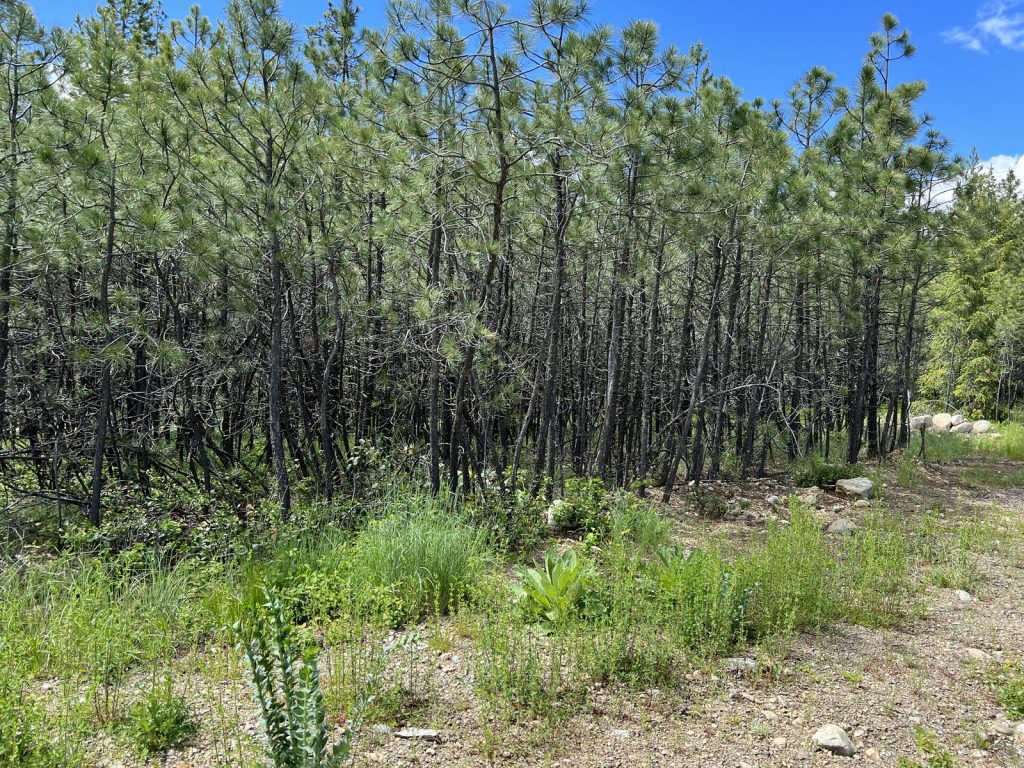
- Lodgepole pine. Grows in thick after fire or disturbance and cannot really thin itself. A stand that came in dense stays dense, and the trees turn tall, skinny, and gangly with tiny crowns fighting for sun. Idaho and Panhandle research is clear on this: overstocked lodgepole stands stagnate, and if they are not thinned early, growth stalls and merchantable yield never shows up. This is a big part of what forestry mulching is knocking down on Bonner County jobs, especially where lodgepole grew in behind older logging or a burn. Around here you will hear this tree called jack pine, black pine, and sometimes red pine, all interchangeably. Idaho Department of Lands uses all of those names for it in their own materials. Technically, true jack pine is a related Canadian species that does not grow west of the Rockies, but when a North Idaho landowner says jack pine, they almost always mean the lodgepole growing on their ground.
- Western larch (tamarack). A deciduous conifer that turns gold and drops its needles every fall. One of the healthiest, most fire-resistant, most disease-tolerant trees in the North Idaho toolbox.
- Ponderosa pine (yellow pine or bull pine locally). Big-barked, warm-site pine. On drier southern exposures. Naturally fire-adapted and disease-tolerant when it is not overcrowded. Young ponderosa before the bark turns orange is what old-timers around here mean by bull pine.
- Western red cedar. Wet-site tree, lakeshore and drainage bottoms. Moderately susceptible to root rot but generally holds up well when the site is right.
- Western white pine. Idaho’s state tree. Once the dominant tree across much of North Idaho, knocked back by white pine blister rust to a fraction of its former range.
- Western hemlock, subalpine fir, Engelmann spruce. Present in smaller amounts, more common at elevation or on cooler, wetter aspects.
- Aspen, birch, cottonwood. The hardwoods. Often overlooked but important. Hardwoods are immune to the conifer root diseases and they add real fire resilience along wet edges.
The healthy North Idaho stand is a mixed stand. A couple of these species together, at spacing that lets crowns breathe, with a live understory that is not stacked from grass to canopy.
Why the forest is sick
Three overlapping pressures explain almost every dying tree in Bonner County right now.
1. A century of fire suppression left the stands too crowded
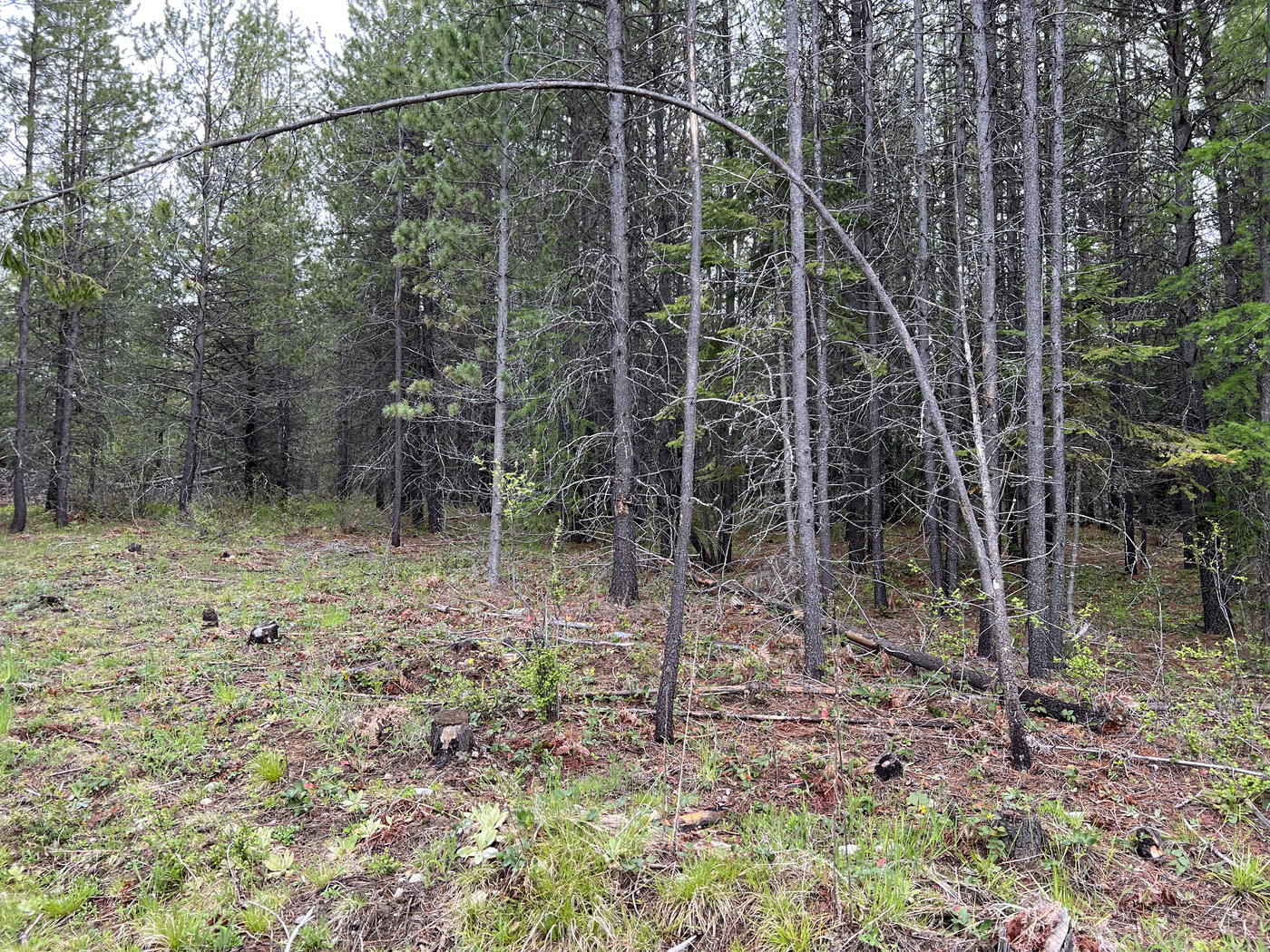
Before roughly 1910, low-intensity ground fires ran through these forests every 10 to 30 years and thinned them naturally. Fire kept the pines and larches on top, kept the understory open, and killed the small trees before they became ladder fuel. When we stopped those fires, the trees kept growing in. Most private stands in Sagle and Sandpoint are now carrying two to three times the tree density the site can actually support on the water and nutrients it has.
Idaho Department of Lands’ rule of thumb for Douglas-fir beetle: stands with more than 120 square feet per acre of basal area are meaningfully more susceptible to attack. Most unmanaged private stands here are well above that.
2. Drought stress makes trees easy targets
The last several years across the Northern Rockies have run drier and warmer than the long-term average. The U.S. Forest Service’s recent regional summaries specifically call out multi-year drought as the reason trees across northern Idaho and western Montana are more vulnerable to bark beetle attack. A crowded stand in a drought year is a stand full of trees that cannot produce enough pitch to push a beetle back out of the bark.
3. Windstorms create beetle feedlots
Two big weather events pushed this to a head recently. A December 2025 windstorm and an April 2026 event created large blowdown across Boundary, Bonner, and Kootenai counties. Downed green timber is the number-one thing bark beetles look for. They build up in the down logs, then emerge in flight season and attack surrounding standing trees.
IDL issued a public bulletin in March 2026 asking landowners to move, burn, or chip down timber before June 2026 to prevent pine engraver buildup, and to have Douglas-fir and larch blowdown managed by late winter 2027 to prevent a Douglas-fir beetle wave in spring 2027. The U.S. Forest Service announced an emergency salvage project across those same counties in June 2026 for the same reason.
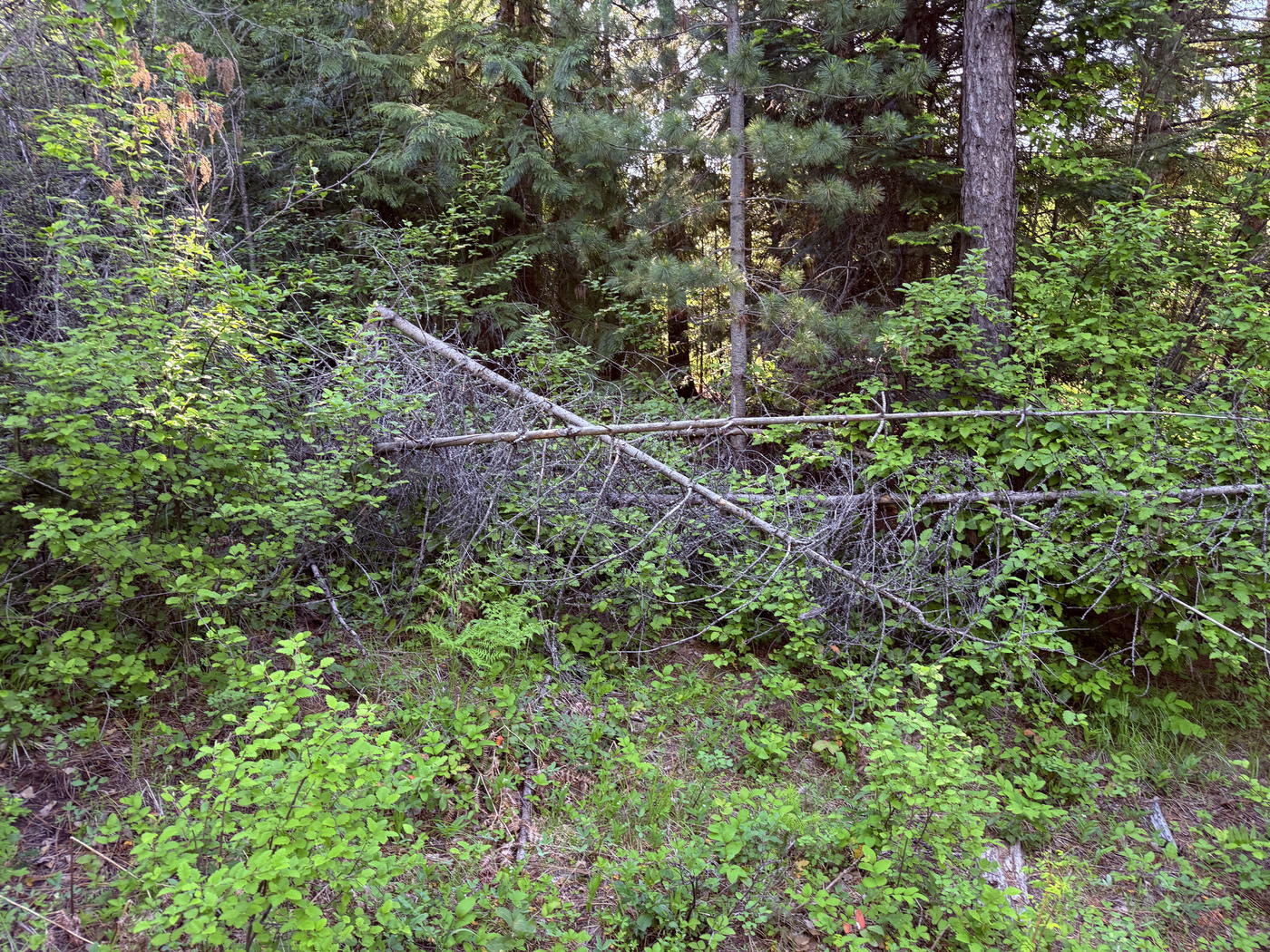
If you had blowdown on your property in the last two winters and it is still lying on the ground, that is the single most important thing to address right now.
Part 1: How to read your forest
Walk your property with these signs in mind. You do not need to identify the specific insect or fungus. You just need to identify that something is off, and roughly where.
Bark beetles: the fastest visible killers
Douglas-fir beetle. Targets Douglas-fir, especially large-diameter trees over about 12 inches. Most damage happens in older, denser stands. Signs: reddish boring dust in bark crevices May through June, pitch tubes on the trunk, fading crowns that go from green to yellow to red-orange over the year after attack. Once a tree is successfully attacked it cannot be saved. IDL mapped mortality on about 20,000 Idaho acres in 2025.
Mountain pine beetle. Targets ponderosa, lodgepole, and western white pine. In northern Idaho, most recent activity has been northwest of Bonners Ferry and south of Kellogg, but stressed pines anywhere in the region are at risk. Signs: pitch tubes low on the trunk, boring dust, whole-tree crown fade the year after attack. About 17,000 acres damaged statewide in 2025.
Pine engraver beetle. A fast-breeding beetle that builds up in slash and downed pine 3 to 12 inches in diameter, then attacks nearby healthy pine. This is the beetle most tied to the recent blowdown events.
Fir engraver beetle. Attacks grand fir and true firs. Often follows drought or root disease. Signs: patches of dead branches, top-kill, or whole-tree fade in grand fir. This is the beetle most tied to the grand fir mortality you are seeing across the valley right now. Idaho Department of Lands’ own guidance on managing it is direct: the most effective long-term move is to reduce the amount of grand fir growing in the stand.
Root diseases: the slow, invisible killers
Root disease is the leading cause of growth loss and mortality across northern Idaho, more than any single bark beetle. The three that matter on private ground here are Armillaria root disease, laminated root rot, and Schweinitzii root and butt rot. All three thrive on the same species: Douglas-fir and grand fir are highly susceptible, western larch and the pines are largely tolerant.
Signs on the ground:
- Small openings in a stand where several trees died over the same few years and nothing has grown back well
- White fungal fans under the bark near the ground line
- Basal pitch flows, sap oozing at the base of the trunk
- Trees blowing down at the stump with rotten roots visible
- Fading crowns in scattered trees, especially in Douglas-fir and grand fir
Root disease does not respect property lines. If your neighbor has an old root disease pocket, it walks slowly into your ground through root contact. The rot survives in stumps for decades after the tree is gone.
White pine blister rust
An introduced fungus that has been killing western white pine and whitebark pine across the West for over a century. Trees show a swollen, cankered stem, orange staining, and dead tops or branches. If you have white pine that is not visibly cankered, keep it and protect it. Rust-resistant white pine seedlings are one of the recovery stories of North Idaho forestry.
Drought and general stress
Beetles and disease do their worst work on trees that are already weak. Signs of a stressed stand:
- Thin, off-color crowns across many trees, not just a few
- Small annual needle growth
- Cones stacked heavy on struggling trees (a stress response)
- Understory drying out earlier every summer
Part 2: What forest health has to do with fire
Every problem above is also a fire problem.
- Dead standing trees cure to firewood-dry within a couple of seasons and light easily.
- Overstocked stands carry fire from crown to crown once it gets moving.
- Ladder fuels (brush, small trees, and low branches) take a ground fire into the canopy.
- Blowdown and dead-and-down material carry fire fast along the ground and burn hot enough to sterilize the soil.
The forest that resists a wildfire is the same forest that resists beetles and root disease. Fewer trees per acre, more species mix, larger fire-tolerant species (larch, ponderosa) on top, no ladder from grass to canopy, and no piles of dead down material. Forest health work and fire mitigation work are the same job.
Bonner County has been treating hazardous fuels on private ground for years through IDL grants and county cost-share, and the science on this is settled: a properly thinned stand with a maintained defensible space around structures dramatically reduces the intensity of a wildfire moving through the property.
Part 3: What it does to your view and your property value
Sick forest also looks sick. Red-crowned trees stand out against a green ridge from a mile away. Gray snags accumulate. Dead-tops crown out the skyline. Blowdown makes a property look neglected.
For someone selling a view lot in Sagle or Sandpoint, this matters. A parcel that reads as a healthy, well-kept forest with visible larch and ponderosa on top of a clean understory looks and prices differently than a parcel that reads as a dying stand. The work that fixes the health problem is the same work that fixes the view.
Part 4: What to actually do
Two tools do the real work on a Bonner County private parcel, and both of them are what Premier Land Service is set up to run.
Forestry mulching for understory, ladder fuels, and small-diameter regen
Forestry mulching grinds standing brush, small trees, doghair pine regen, and light slash in place, leaving a mulch layer on the ground. It is the fastest, cleanest, and cheapest way to:
- Open the understory in an overstocked stand
- Remove the ladder fuel that carries fire into the canopy
- Break up a wall of dead-and-down material after a windstorm
- Clean up blowdown too small to log
- Reset defensible space around structures
- Knock down overstocked lodgepole and doghair regen that will never grow into anything but ladder fuel
Mulching is not the answer for large, dead, or diseased sawtimber. That is a logging job. Our forestry mulching cost guide covers 2026 per-acre ranges for Sagle, Sandpoint, and the surrounding area.
Selective logging to remove the trees that are already gone or are feeding the next round
Selective logging is a targeted harvest: take out specific trees and leave the rest. On a forest-health job, that usually means:
- Sanitation cuts. Pulling out beetle-hit or beetle-attractive trees before the next flight season. IDL’s guidance on Douglas-fir beetle specifically calls for removing infested green trees before snowfall so the next generation of beetles does not emerge into the surrounding stand the following spring.
- Salvage cuts. Recovering merchantable logs out of blowdown before it becomes beetle brood material or a fire hazard.
- Density reduction. Thinning a crowded stand down toward the 120-square-feet-per-acre-and-under range that stops being an active beetle target.
- Species conversion. Favoring larch, ponderosa, and other pines on retention and pulling out the trees that are actively dying and feeding the next round. On most Bonner County ground right now, grand fir is at the top of that hit list, followed by root-disease-hit Douglas-fir. IDL’s own recommendation on root-disease and fir-engraver ground is the same: plant and retain tolerant species (larch, pines) and reduce the susceptible ones (grand fir, Douglas-fir).
Selective logging is where the merchantable-log conversation matters. On the right parcel, a well-planned selective harvest can pay for a significant portion of the fuel reduction work by turning the trees that need to come out into logs a mill will buy.
Defensible space and structure protection
Anywhere within 100 feet of a house, shop, or outbuilding, the goal is a lean, clean, green zone: crowns not touching, no ladder fuels, dead material cleaned up, and low grass. This is a mulching-and-selective-logging combination and it is a fundable project. IDL’s hazardous fuels reduction grants have paid for exactly this kind of work in Bonner County for years.
What not to do
- Do not leave green blowdown on the ground. After the 2025 and 2026 windstorms, this is the single biggest driver of beetle buildup on private property. Move it, chip it, burn it, or log it.
- Do not stack green firewood next to live trees. Split, debark, and dry it in the sun. Green rounds against a live tree in shade is a bark beetle nursery.
- Do not replant susceptible species in a root disease pocket. If Douglas-fir keeps dying in the same spot, plant larch or pine.
Local wrinkles worth knowing
- IDL is a free resource. Idaho Department of Lands has a Forest Health Specialist and Private Forestry Specialists who will give landowners technical assistance at no charge. Email
ForestHealth@idl.idaho.govor call the Coeur d’Alene office at (208) 769-1525. - Hazardous fuels grants exist. Bonner County has been listed in IDL’s hazardous fuels grant program for years. If your property is in the wildland-urban interface, a portion of your fuel reduction work may be cost-shareable through IDL or the county. Worth asking about before you write a check for the whole job.
- Post-storm timing is real. Beetles have life cycles. Pine engraver in downed pine has to be dealt with before June. Douglas-fir beetle in downed Douglas-fir has to be dealt with before late winter of the following year. Miss the window and you are treating a larger stand next season.
- You do not have to log the whole parcel. Selective, small-scale work on a few dozen problem trees can protect a much larger area if the timing and the target are right.
When to call
If you can point to any of the following on your parcel, the work is cheaper and more effective now than it will be next year:
- Blowdown from the December 2025 or April 2026 windstorms still lying on the ground
- Reddish or fading crowns visible from the house or driveway
- Grand fir or Douglas-fir dying in a cluster or an expanding pocket
- Standing dead trees within reach of structures
- An overstocked stand that has never been thinned
- A defensible space zone that has never been established
We work Sagle and Sandpoint first, Bonner County across the board, and take projects in Kootenai and Boundary counties.
Call 208-603-4777 or email info@premierlandservice.com. Tell us where the parcel is and what you are seeing. We will walk it and put together a phased plan: what to hit first, what can wait, what pays for itself through a selective harvest, and what should be mulched.
Forest health problems, like drainage problems and fire fuels, get worse every season they are ignored. The right time to fix them is before the next flight season, not after it.