
If you’ve started getting quotes for clearing land in North Idaho, you’ve probably heard two very different pitches. One contractor wants to bring in a forestry mulcher and grind everything in place. Another wants to push it all into burn piles or haul it off with a dozer and excavator. Both are called “land clearing” in casual conversation, but they are not the same job, they don’t cost the same, and they don’t leave your property in the same condition.
This guide breaks down the real difference between forestry mulching and true land clearing — when each one makes sense, what each one costs, and how we decide which method to recommend when we walk a site here in Bonner County, Kootenai County, and Boundary County.
What Forestry Mulching Actually Is
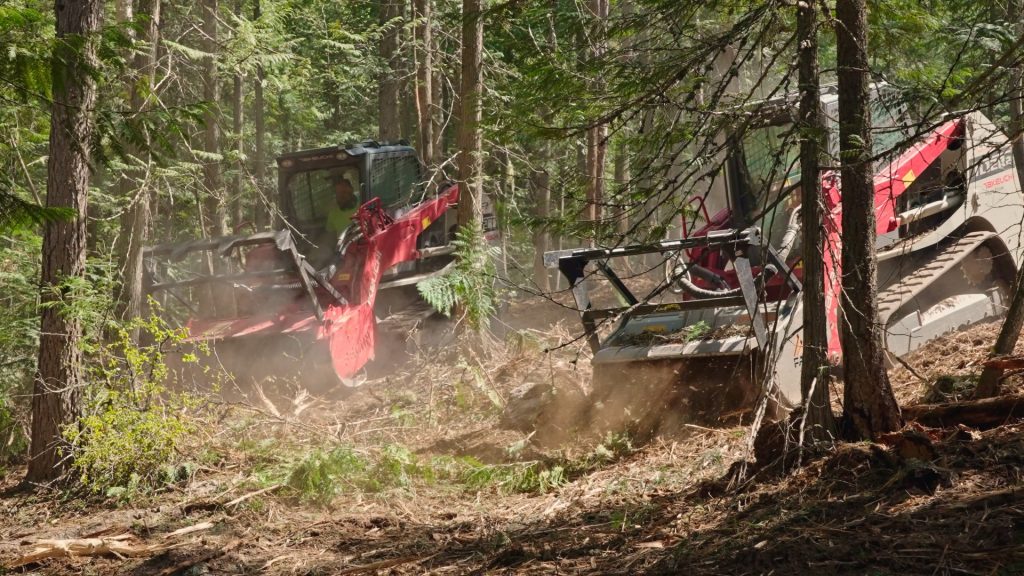
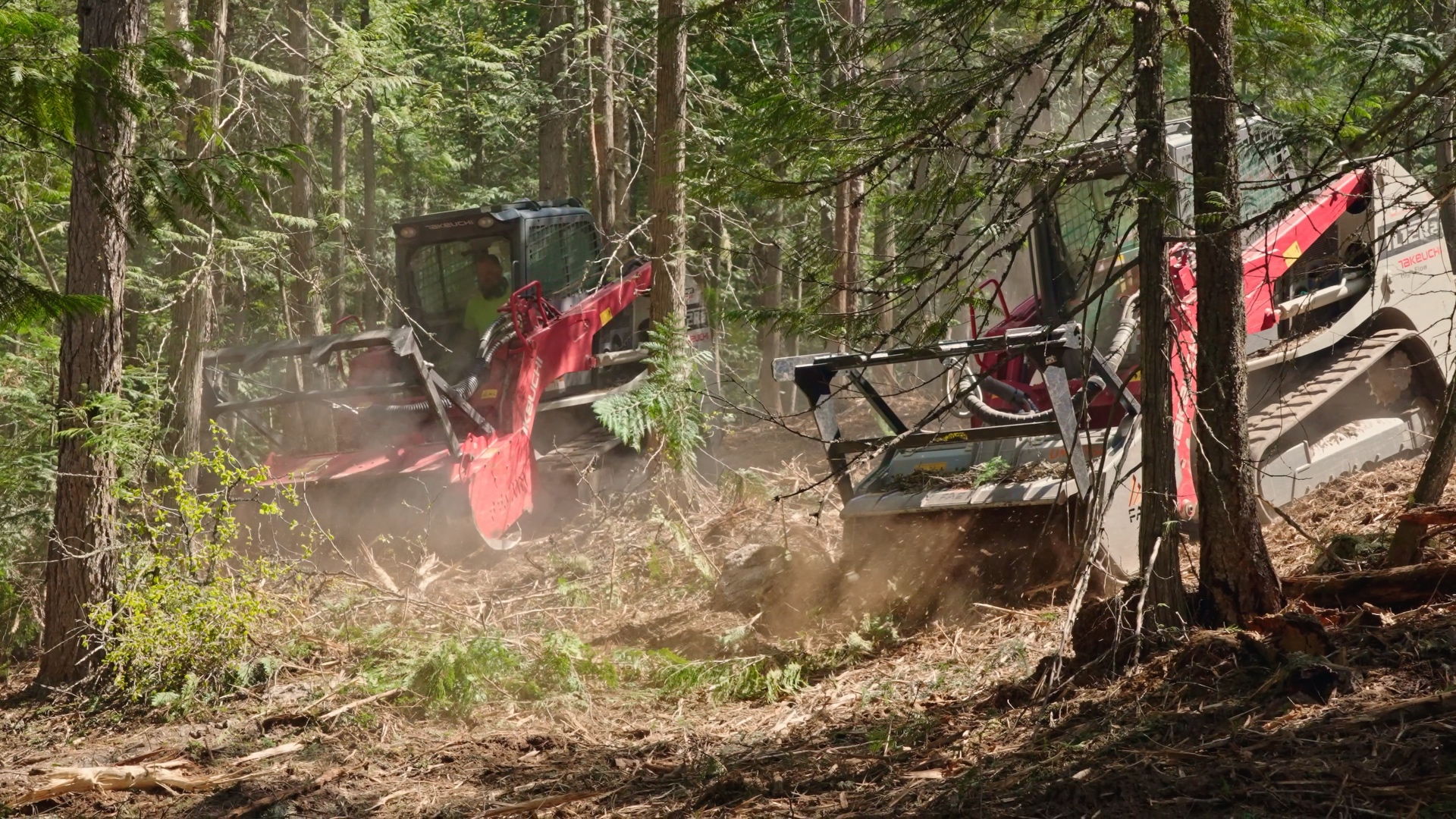
Forestry mulching uses a high-flow track loader with a drum-style mulching head to grind standing trees, brush, and small stumps into a layer of wood chips that’s left on the ground. Nothing gets hauled off. Nothing gets burned. The vegetation that was standing up is now lying down as mulch, usually two to four inches deep depending on density.
For a deeper look at our pricing and what affects per-acre cost, see our forestry mulching cost guide for North Idaho.
What forestry mulching does well
- Minimal ground disturbance. The track loader rides on top of the chip layer. No ripping up topsoil, no exposed mineral soil, no erosion problems.
- No burn permits, no smoke. Big deal in fire season and big deal if you have neighbors close by.
- No haul-off cost. The material stays on site as mulch, which means no dump fees and no parade of trucks.
- One-pass operation. What was forest in the morning is open ground by the afternoon.
- Wildfire fuel reduction. Standing ladder fuels become flat-lying chips that decompose into soil over a few seasons.
What forestry mulching does not do
- It does not remove stumps. Stumps get ground flush, but the root ball stays in the ground.
- It does not grade or level. The ground after mulching is the same shape it was before, just without the trees.
- It does not haul anything away. If you don’t want a mulch layer left behind, this isn’t your method.
- It does not handle large diameter timber economically. Past about 10 inches on the stump, mulching gets slow and expensive fast.
What True Land Clearing Actually Is
When most contractors say “land clearing,” they mean the traditional method: a dozer or excavator pushes the trees and brush into piles, the stumps get dug out, and the material either gets burned in place (with a permit) or hauled off. The job usually ends with grading to leave a clean, buildable surface.
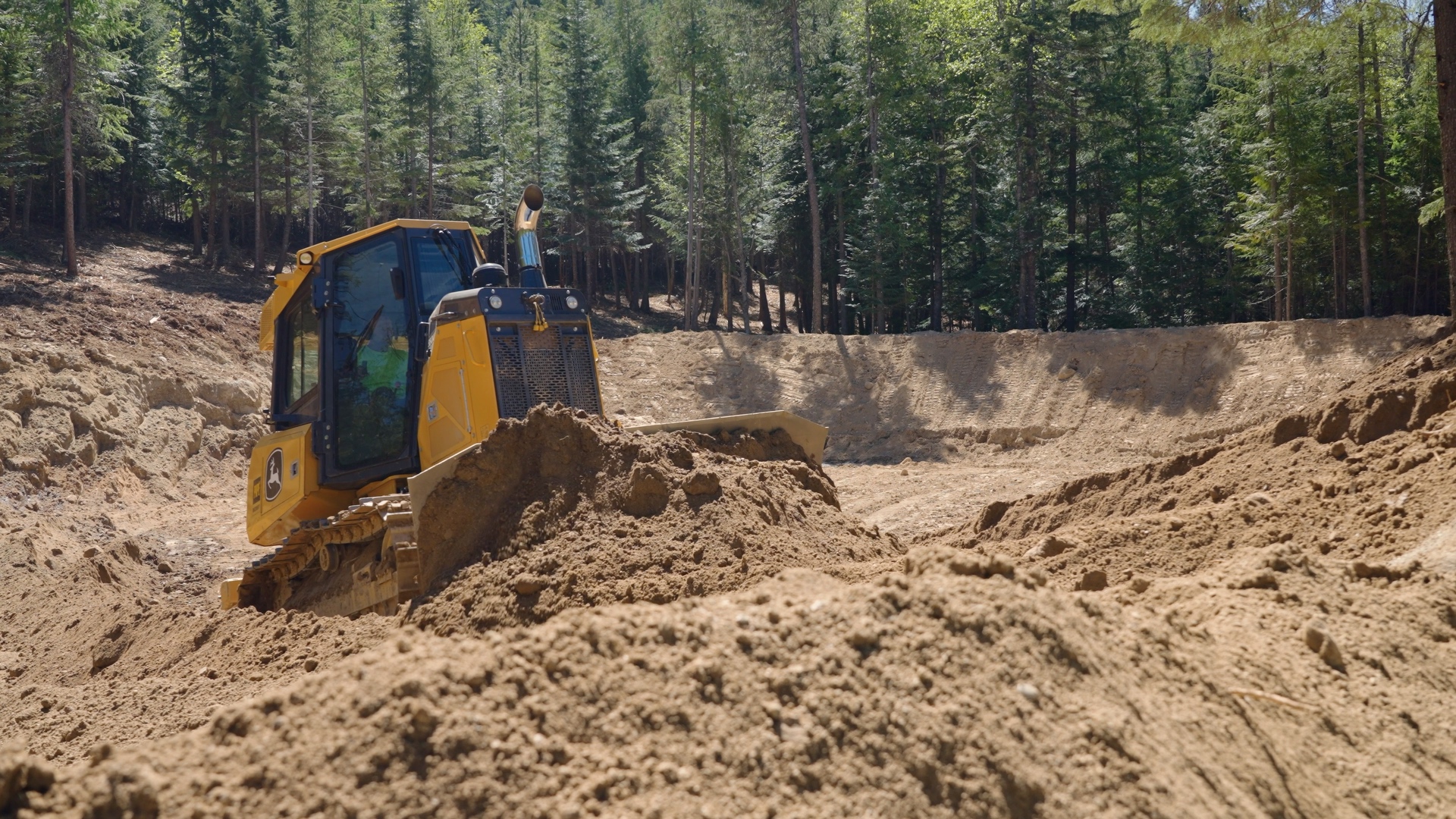
This is what you want when the end goal is a building pad, a driveway, a pasture, or any use that needs the ground actually opened up and reshaped — not just stripped of vegetation. See our land clearing service page for what a full clearing job typically includes.
What true land clearing does well
- Removes stumps and root balls. No buried wood to settle or rot under your future foundation.
- Handles big timber. Large trees that would take a mulcher hours can be felled, limbed, and moved in minutes with the right equipment.
- Leaves bare ground. Ready for grading, ready for compaction, ready for a building pad or septic install.
- Can be combined with grading and dirt work in one mobilization. If you’re already running an excavator and dozer, the rough grade gets done while we’re there.
What true land clearing costs you
- Ground disturbance. The topsoil gets churned. Erosion control matters. Reseeding may be required.
- Burn permits or haul-off. Either you stack and burn (weather dependent, permit dependent) or you pay to truck everything to a disposal site.
- More machines, more days. A typical clearing job runs a dozer, an excavator, and sometimes a dump truck. That’s more equipment moving and more time on site.
- Higher cost per acre on light vegetation. If all you have is brush and small trees, true clearing is overkill and you pay for it.
One upside most contractors won’t mention: merchantable logs
When true land clearing turns up larger trees — typically pine or fir that grades out as sawlog material — those logs can sometimes be sold to a local mill to offset part of the clearing cost. We’re not loggers and clearing isn’t a timber sale, but if a job has good merchandisable material, it’s a byproduct worth capturing. We’ll flag it on the walk-through if it’s there.
Cost Comparison: What You Actually Pay
Here’s how the two methods compare on a typical North Idaho acre. These are real ranges we quote, not contractor averages from somewhere in Texas.
| Factor | Forestry Mulching | True Land Clearing |
|---|---|---|
| Typical cost per acre | $2,500 – $5,500 | $4,000 – $9,000+ |
| Time per acre (moderate density) | 4 – 8 hours | 1 – 2 days |
| Equipment on site | 1 track loader w/ mulcher | Dozer + excavator (sometimes truck) |
| Stumps removed? | No (ground flush) | Yes |
| Grading included? | No | Often yes |
| Burn permit needed? | No | Often yes |
| Topsoil disturbance | Minimal | Significant |
| Material left on site | 2–4″ mulch layer | Bare or graded soil |
How We Pick the Right Method When We Walk Your Site
Joey or a project manager from Premier Land Service walks every property before we quote it. We’re looking at five things to decide which method actually fits the job. This is the conversation that happens before any quote gets written.
1. What’s the end use?
Building a house? You need true clearing. The stumps have to come out, the pad has to be flat, the soil has to compact properly. Mulch under a foundation is a problem waiting to happen.
Opening up views, creating defensible space against wildfire, thinning a parcel for recreation or improved access? Mulching is almost always the right call. You don’t need bare dirt — you need fewer trees and less ladder fuel.
2. How big is the timber?
If most of what we’re removing is brush and trees under 8 inches on the stump, mulching is faster and cheaper. Once we’re into larger pine or fir, a chainsaw and an excavator move that material faster than a mulcher can grind it.
3. What’s the terrain?
Steep slopes change everything. On flatter ground around Sagle, Sandpoint, and Athol, either method is straightforward. On the kind of grades we run into above the lakes or back in the mountains, a mulcher leaves less scar and reduces erosion risk significantly. For really steep or access-restricted work, we bring in a smaller specialty excavator that goes places the larger track loaders can’t.
4. Are there fire or smoke restrictions?
Late summer and fall in North Idaho often means burn bans. If your project lands in that window and you want true clearing, you’re either hauling everything off (expensive) or waiting weeks for permit conditions to lift. Mulching has no smoke and no permit issue.
5. What’s the access like?
If a 30-foot dump truck and lowboy can’t physically reach the back of your parcel, hauling off cleared material isn’t realistic. Mulching solves access problems because there’s nothing to haul.
When We Recommend a Hybrid Approach
Plenty of real-world North Idaho projects don’t fit cleanly into one bucket. A common setup we run:
- True clearing on the building footprint and driveway. Stumps out, ground graded, ready for construction.
- Mulching on the surrounding acreage. Defensible space, view corridors, easier ongoing maintenance — without the cost of full clearing on land you’re not building on.
This combination usually beats either pure approach on cost and on final outcome. We do this on a lot of rural Bonner County and Kootenai County builds.
Quick Decision Guide
Use this as a starting point. Every site is different, which is why we walk every project before quoting it.
- Building a home or shop? True land clearing (at minimum on the footprint).
- Installing a driveway or road? True clearing for the driveway corridor.
- Creating defensible space for wildfire? Forestry mulching.
- Opening up lake or mountain views? Forestry mulching.
- Thinning a recreational parcel? Forestry mulching.
- Burn ban in effect and you need to clear now? Forestry mulching.
- Pasture conversion? Usually a hybrid — clearing on the wettest or stumpiest areas, mulching on the rest.
- Septic install prep? True clearing (the drainfield needs clean ground).
Why It Matters Who’s Doing the Walk-Through
The biggest mistake we see homeowners make is hiring a contractor who only owns one type of equipment. A contractor with only a dozer will tell you you need true clearing. A contractor with only a mulcher will tell you mulching solves everything. Both are wrong about half the time.
Joey or a project manager from Premier Land Service walks every project and writes every estimate. We run both forestry mulchers and full excavation equipment, so the recommendation isn’t shaped by what’s parked in the yard — it’s shaped by what your site actually needs.
Ready to Find Out Which Method Fits Your Property?
If you have land in Sagle, Sandpoint, Bonner County, Kootenai County, or Boundary County and you’re not sure whether you need forestry mulching, true land clearing, or a combination of the two, we’ll walk your property and give you a straight answer.
Call Premier Land Service at 208-603-4777 or request a site visit through our contact form.