
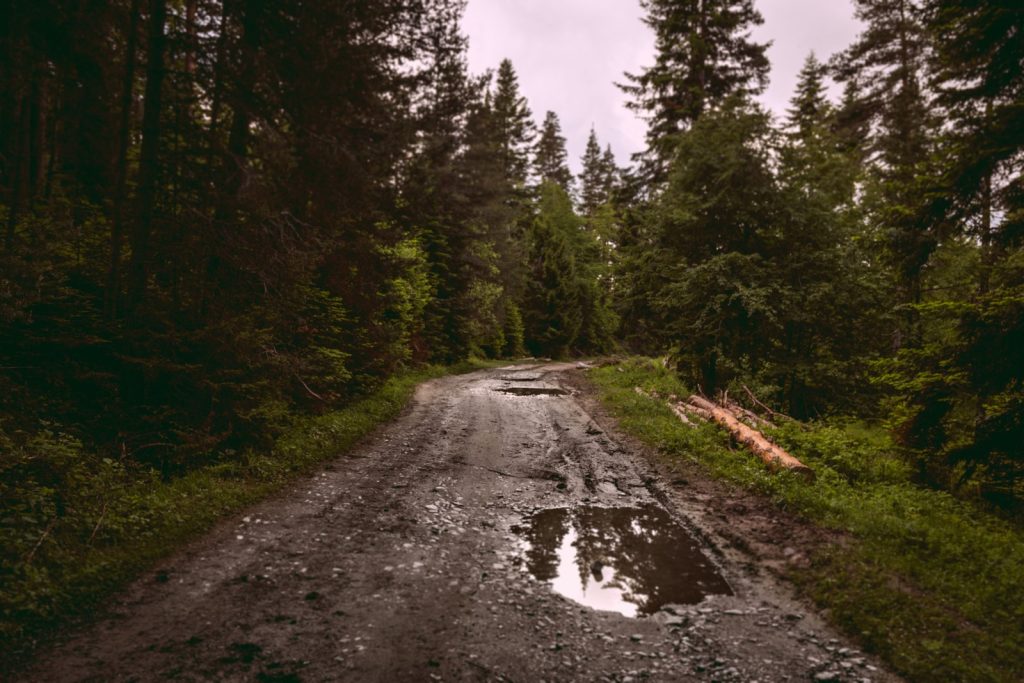
If you have standing water, a soft driveway, or a pad that will not stay firm on a parcel in Sagle, Sandpoint, or anywhere in Bonner County, the problem does not fix itself and it does not stay the same. Water finds a path, and every wet season that path gets deeper, softer, and more expensive to correct.
Drainage is one of the few site issues that behaves like wildfire fuel. Ignored, it gets worse every year. Caught early, it is one of the cheaper problems on a rural parcel to fix. This guide covers both sides of the same job: doing it right the first time on a new site, and catching a problem before it becomes a full rebuild.
If you already have a wet spot, a soft spot, or a driveway that will not stay firm, call 208-603-4777 or email info@premierlandservice.com. We will walk the site and give you a straight answer on what it will take to fix it.
Why drainage problems get worse with time
Every year a drainage issue is ignored, the fix gets bigger and the bill gets larger. The reasons are physical, not theoretical:
- Water erodes. A slow trickle across a driveway becomes a rut, then a channel, then a washout. What started as a load of gravel becomes a full culvert install and a section of road rebuilt.
- Water saturates. A wet spot next to a house pad softens the subgrade under the pad. Give it two or three seasons and you are looking at settlement, cracked slab, or a foundation call.
- Water freezes. North Idaho ground freezes hard. Water trapped in a poorly draining base freezes, expands, heaves the surface, and thaws into mud. Every winter makes the next spring worse.
- Vegetation moves in. Wet spots grow reeds, willows, and eventually seasonal wetland indicators. Once a lot reads as wetland on a delineation, your options and your permits change.
The pattern is the same every time. A $2,000 drainage swale at the right moment becomes a $12,000 driveway rebuild two years later, or a $30,000 pad repair five years later. Doing it right out of the gate is almost always the cheapest path.
Part 1: Doing it right on a new parcel
If you are still in the planning stage on a Sagle, Sandpoint, or Bonner County parcel, drainage is not the last item on the site-prep list. It is the item that dictates where everything else goes.
1. Read the parcel before you pick the building envelope
Before you commit to a building spot, walk the parcel in the wet season if you can. Late April through early June is the honest test. A lot that looks bone dry in August can have three inches of standing water at the base of the same slope in May.
Look for:
- Standing water or saturated ground away from the road
- Reeds, cattails, sedges, willows, or bright green patches in an otherwise dry area
- Old drainage cuts, culverts, or ditches from prior owners
- Slope direction and where water naturally wants to go
Your builder and your excavator both need to know this before the pad location is final. Moving the pad 40 feet uphill in the planning stage is free. Moving it after the driveway is in is not.
2. Grade for water first, then for aesthetics
North Idaho parcels usually have enough slope to work with. The goal on a new site is to shape the ground so water moves away from the house pad, away from the driveway, and away from the drain field. That means:
- Positive slope away from the pad in every direction. A 2% fall for the first 10 feet minimum, then whatever the natural grade gives you.
- Driveway crown of about 2%. Water sheets off both sides into ditches or into the shoulder, not down the length of the drive.
- Ditches or swales along the uphill side of the driveway to catch water before it crosses the surface.
- Culverts at every low crossing. Sized for the drainage area above them, not for the last dry summer.
If you are reading our full site prep guide, this is the part where forestry, road in, and pad shaping all overlap. Getting the sequence right means the drainage is built into the site, not added on later.
3. Handle the drain field and the well separately
Panhandle Health District treats the drain field as its own drainage system. It needs unsaturated ground below it to work. If you put the drain field in a low spot or in a location that catches runoff from the driveway or the roof, it will fail early, and there is no cheap fix for a failed drain field.
The rule is simple. The drain field goes uphill of the wet spots, not downhill. Runoff from roof, driveway, and cleared areas gets directed around the drain field, never through it.
Our septic install guide covers the system types and cost ranges in more detail — gravity, gravity to pump, and cap-and-fill are the systems we install most in Sagle and Sandpoint.
4. Budget for drainage on the site plan
A well-graded new site with proper ditches, culverts, and swales usually runs somewhere in the range of $3,000 to $10,000 as part of the broader site-prep package, depending on parcel size, slope, and how much material has to move. A parcel with real drainage challenges — a spring, a wet seasonal channel, an engineered detention basin — can push $15,000 or higher.
Compared to the cost of fixing a failed pad or a washed driveway, that is cheap money. Compared to skipping drainage entirely, it is the difference between a house that stays dry and a house that does not.
Part 2: Fixing it when it was not done right
Most of the drainage calls we get are not on new sites. They are on parcels that were graded years ago, or never graded at all, and the problem has been getting worse every season. The fix is almost always cheaper today than it will be next spring.
Symptom 1: standing water on the lot
Water sits in a spot for days or weeks after rain or snowmelt. Sometimes there is a wetland-indicator plant community starting to establish.
What is usually happening: Runoff from uphill is being trapped by a berm, a road bed, or a change in soil type. Or the natural drainage path was interrupted by a prior owner and has never been reopened.
The fix: Cut a drainage path from the low spot to an existing swale or ditch that outlets legally off the parcel. On flat parcels this may mean building a swale system; on steeper parcels it usually means reopening a natural path. Expect $1,500 to $6,000 for a straightforward corrective swale, more if the outlet is far or if fill has to be hauled off.
The cost of waiting: Once the spot reads as jurisdictional wetland — reeds, sedges, and a wet-season history — your ability to fix it drops sharply. You are then talking about a delineation, a permit process, and possibly compensatory work. Fix a wet spot while it is still just a wet spot.
Symptom 2: soft or rutted driveway
The driveway holds water, ruts under a loaded truck, or turns to mud every spring. You keep adding gravel and it keeps disappearing.
What is usually happening: Either the driveway has no crown and no ditches, or the base was never built properly, or both. Water is sitting in the surface and in the base course, saturating everything.
The fix: Depends on how far gone it is. A driveway with good base but a lost crown can often be rebladed and reshaped, with new ditches cut and one or two culverts added, for $3,000 to $8,000 on a typical run. A driveway where the base has failed and the road bed itself is soft needs to be rebuilt — dig out the soft material, put in geotextile fabric, rebuild the base and cap. That runs $8,000 to $20,000 on a typical residential drive, more on long runs. Our driveway construction guide covers the base and cap detail if you want the material breakdown.
The cost of waiting: Every load of gravel you dump on a driveway that has no drainage disappears into the soft base within a season or two. You are paying for gravel that never stays. Fix the water problem and the gravel actually lasts.
Symptom 3: soft or settling house pad
The pad feels spongy underfoot, water pools next to the foundation, or you are starting to see settlement cracks in the slab or foundation wall.
What is usually happening: The pad is either sitting in a wet zone, or roof runoff and surface water are being directed into the backfill and saturating the ground under the pad.
The fix: Cut a perimeter drain around the affected side of the pad, tied into a daylight outlet or a dry well. Regrade the surface around the house to slope away in every direction. Add gutter and downspout extensions that carry roof water at least 10 feet from the foundation. Foundation-drain retrofits on an existing house typically run $4,000 to $15,000 depending on access and how much of the perimeter needs work.
The cost of waiting: Settlement gets worse. Slabs crack. Foundations move. The retrofit gets more invasive and the interior damage starts costing more than the drainage fix.
Symptom 4: washed-out driveway or culvert
A section of driveway blew out in a heavy rain or during spring melt. Or the culvert is undersized, plugged with debris, or crushed.
What is usually happening: The drainage area above the culvert delivers more water than the culvert can pass, or the culvert has failed and water is finding a new path.
The fix: Right-size and reset the culvert, armor the inlet and outlet with rock, and re-establish the crown and ditches on both sides. A typical culvert replacement in the 18 to 24 inch size runs $2,500 to $6,000 installed. Larger culverts, deeper burials, or longer sections cost more.
The cost of waiting: A partial washout becomes a full washout. The next heavy rain takes out the road entirely, and you are looking at emergency work at emergency prices, plus whatever damage the runoff did downhill.
Local wrinkles that shape drainage work in Bonner County
- Bonner County stormwater rules apply on the ground you disturb. A residential driveway and pad rarely hit the thresholds that trigger a formal stormwater permit, but the county can require best-management practices on larger disturbances. The safe move is to build to good practice regardless.
- Panhandle Health District has an interest anywhere the drain field could be affected. Runoff onto or through a drain field is a health-district issue, not a nuisance issue.
- Fish-bearing streams and wetlands change the calculus. Any work near a stream, a mapped wetland, or a shoreline setback needs to be scoped carefully. What looks like a simple ditch cut can be a permitted crossing.
- North Idaho freeze-thaw is real. A drainage fix that ignores frost depth will not last. Culverts get set below the frost zone, and any drain that has to work in April has to be built for the way ground behaves in April.
When to call for a drainage walk
If any of the following are true on your parcel, the fix is cheaper today than it will be next spring:
- Water stands in the same spot every year and it is spreading
- Your driveway needs gravel added every year and never stays firm
- You have a low spot near the house pad or drain field
- A culvert is crushed, plugged, or too small
- You are about to buy a raw parcel and the wet season is coming
We work Sagle and Sandpoint first, Bonner County across the board, and take projects in Kootenai and Boundary counties.
Call 208-603-4777 or email info@premierlandservice.com. Tell us where the parcel is, what you are seeing, and when you first noticed it. We will walk it and give you a straight answer on what it needs, what it costs, and what happens if it gets left alone another season.
Drainage problems, like fire fuels, only get worse with time. The right time to fix one is before the next wet season, not after it.