
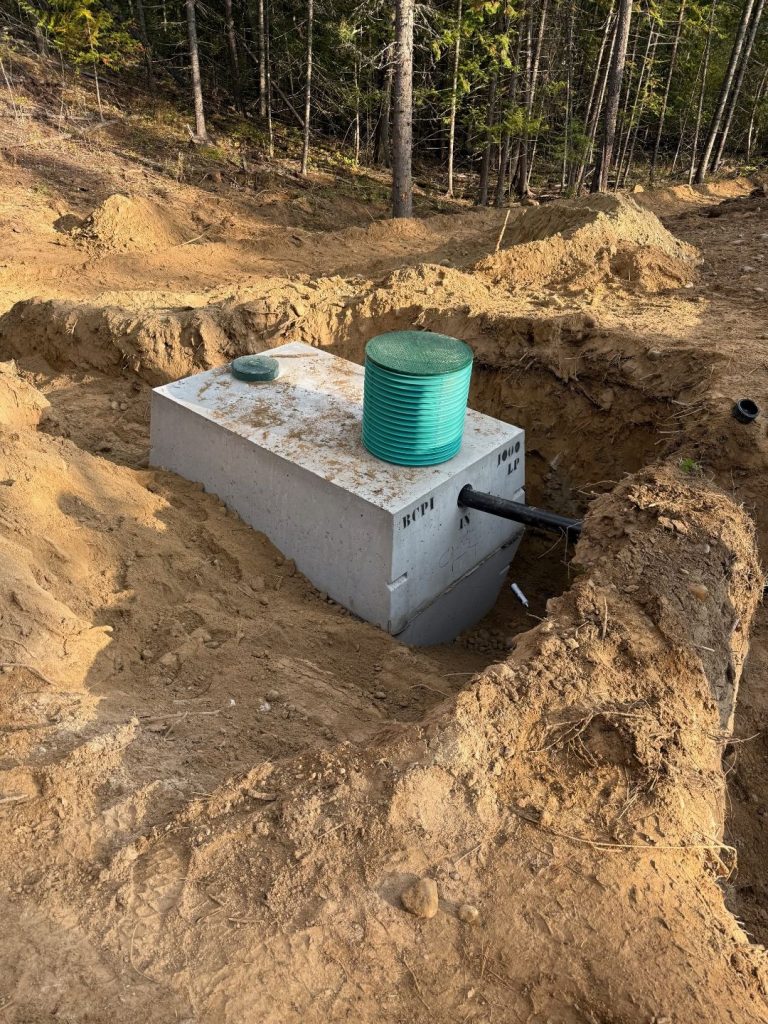
If you’re building in Sagle, Sandpoint, or anywhere else in Bonner County outside a municipal sewer service area, you’re putting in a septic system. There’s no avoiding it. And in Bonner County the septic install is often the single biggest piece of site infrastructure after the driveway.
This guide walks through what a septic system actually costs in Sagle, Sandpoint, and the rest of Bonner County, how the permit process works through the Panhandle Health District, and the site-specific factors that drive cost up or down. We’ll also cover the systems we install most often here — standard gravity, gravity to pump, and capping fill — and the less-common alternatives that handle the trickier sites.
Who’s in charge of septic permits in Bonner County
All septic permits for Bonner County go through the Panhandle Health District. Their Sandpoint office is at 2101 W. Pine St., and they handle every site evaluation, permit application, and final inspection in Bonner County — including Sagle, Sandpoint, Dover, Ponderay, Kootenai, Hope, and the rest of the county.
If you’ve never done this before: the City of Sandpoint itself doesn’t issue septic permits. Bonner County doesn’t either. It’s Panhandle Health District, every time, for any septic install on private property.
The permit process, step by step
This part trips up a lot of property owners because the order matters and the timing can stretch the schedule by weeks if you don’t plan it.

Step 1: Site evaluation and test holes. A licensed installer or excavation contractor digs test holes at the proposed drainfield location — an 8-foot-deep hole in the center of the proposed drainfield, at least 3 feet wide, sloped on one side so the Environmental Health Specialist can walk in. A second hole is dug approximately 75 feet away. In well-drained coarse (Type A) soils the test hole may need to go 10 feet deep. Panhandle Health sends an EHS out to inspect the soil profile, classify it, and determine what kind of system the site can support.
Step 2: Application and fee. Once soil is classified, you submit a permit application. The current fee for a Subsurface Sewage Permit is $950. Permits may take up to 10 working days to issue after PHD is contacted about testhole completion, and are valid for one year.
Step 3: Design. Basic systems — standard trench, standard bed, capping fill, two-cell infiltrative, and gravelless distribution — can be designed by a licensed Basic Installer. Complex systems — pressure distribution, sand mound, intermittent sand filter, ETPS, and others — require a licensed Complex Installer, and depending on the design may require an Idaho-licensed Professional Engineer.
Step 4: Installation. A licensed installer puts the system in. Bonner, Kootenai, and Boundary Counties all fall under the same Panhandle Health District licensing system. Don’t hire anyone who isn’t currently licensed as a Basic or Complex Installer for the system type you’re building.
Step 5: Final inspection and cover. The system must be inspected and approved by Panhandle Health before it’s covered with dirt. An inspection tag is left on site — green for approved, red for disapproved. If you cover the system early, you’ll dig it back up.
Realistic timeline from start to finish: 4 to 10 weeks in our experience, depending on Panhandle Health’s current workload and how quickly the design phase moves. Plan ahead.
Real cost ranges for septic systems in Sagle, Sandpoint, and Bonner County
These are 2026 numbers based on what we and other contractors are quoting locally. Cost depends almost entirely on the soil and slope at your site.
| System type | Typical install range | When it’s used |
|---|---|---|
| Standard gravity | $10,000 – $18,000 | Good soils, flat or gently sloped sites, adequate vertical separation |
| Gravity to pump | $13,000 – $22,000 | Drainfield uphill of tank, or good soils on a sloped site |
| Capping fill | $18,000 – $30,000 | Shallow soil to a limiting layer — engineered or select fill placed to gain vertical separation |
| Sand mound | $25,000 – $40,000 | Poor soils, high water table, or when a fully above-grade drainfield is required |
| Pressure distribution | $20,000 – $32,000 | Marginal soils or sloped sites where even distribution is required |
| ETPS / advanced treatment | $30,000 – $50,000+ | Sensitive sites, lake-front, or where nutrient reduction is required |
Add to that:
- PHD subsurface sewage permit: $950 (non-refundable)
- PE design (if required): $1,500 to $4,000 typical
- Soil test hole excavation: $500 to $1,500 typically rolled into the installer’s fee
The bulk of the cost is the system itself — tank, pump (if pressurized), pipe, gravel, and drainfield construction — plus the labor and equipment time to install it.
Where the cost actually goes
When Joey or a project manager from Premier Land Service walks a site to bid a septic system, here’s what’s driving the number:
Soil quality. Coarse sand and gravel around Sagle and Sandpoint drain well — those are cheap sites. Heavy clay, glacial till, or sites with bedrock close to the surface require larger drainfields, special distribution methods, or full mound systems. We’ve seen identical-size homes cost 3x different to permit and install just because of the soil.
Slope. PHD generally will not permit a drainfield on slope in excess of 20 percent (higher slope may be considered on a case-by-case basis). Sites well under that limit are straightforward. Steeper sites push you into pressure distribution or engineered designs with serious erosion control requirements. North Idaho has plenty of beautiful steep building sites that cost twice as much for the septic.
Distance from house to drainfield. Long runs of sewer pipe, lift stations to pump uphill, multiple distribution boxes — every foot adds cost.
Water table and drainage. Wet sites near creeks, marshes, or low spots often need mound systems even when the surface soil looks fine. The drainfield has to sit a minimum vertical distance above seasonal high water.
Setback constraints. PHD minimum horizontal setbacks include: drainfield 100 ft from any well, 100 to 300 ft from streams / lakes / ponds (depending on soil type), 5 ft from property lines, 20 ft from a basement, and 10 ft from a slab or crawl-space foundation. On smaller parcels — and especially lake-area lots near Pend Oreille — these setbacks can force expensive design choices.
Drainfield size. Sized based on bedroom count and soil type. A 3-bedroom home on coarse sand needs much less drainfield than the same home on tight silt. The size of the drainfield is one of the biggest cost drivers people don’t think about.
The three systems we install most in Sagle and Sandpoint
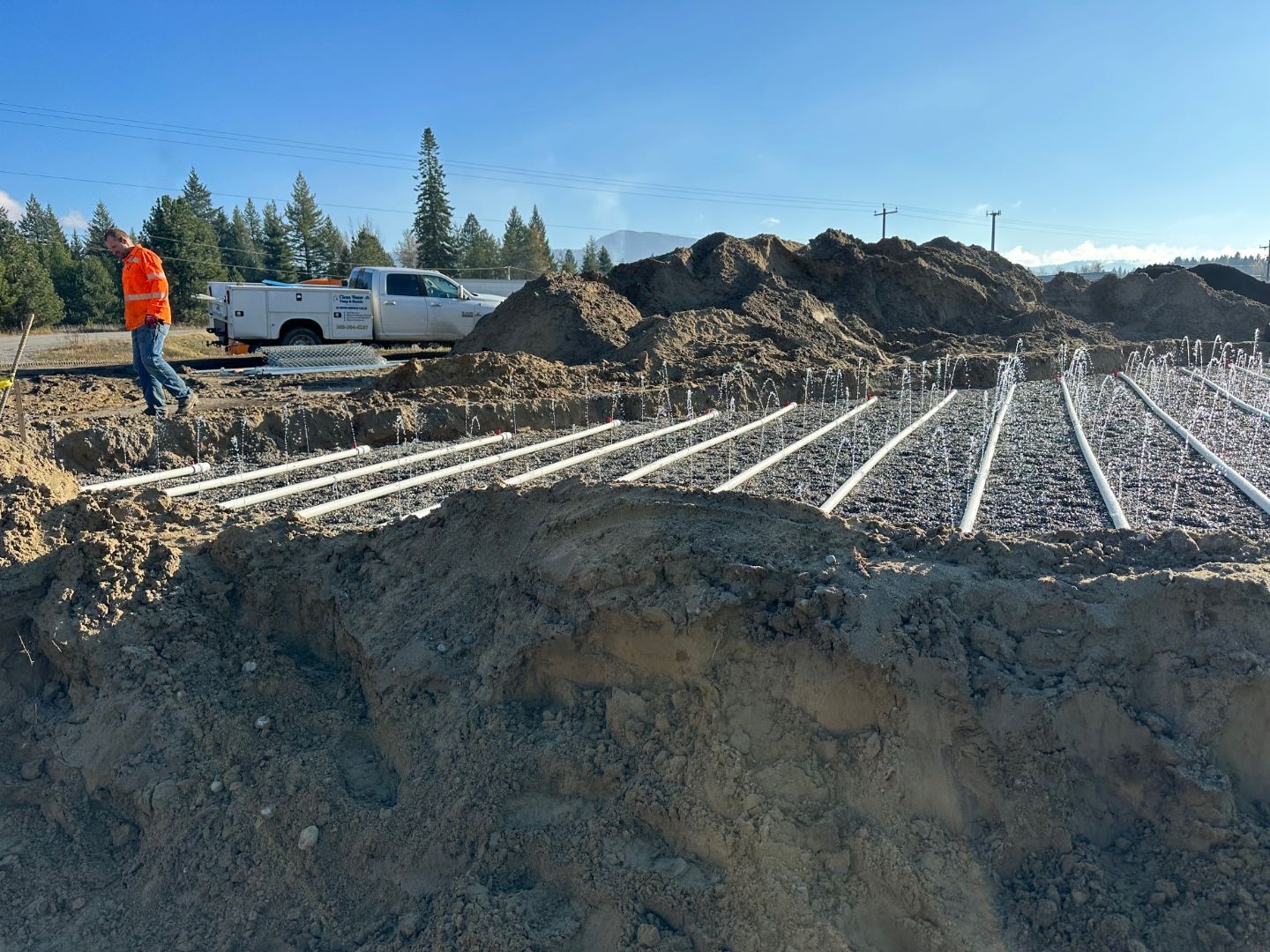
Most of the homes we install septic for in Bonner County get a standard gravity system, a gravity-to-pump system, or a capping fill. Pressure distribution and mound systems show up less often but do come up.
Standard gravity. Septic tank flows by gravity into the drainfield. Drainfield pipes are perforated and lay level in gravel-filled trenches. Effluent drains out and percolates into the soil. Cheapest option. Requires good soils, a site where the drainfield sits below the tank, and adequate vertical separation to any limiting layer.
Gravity to pump. Septic tank discharges to a pump chamber, and the pump lifts effluent up to a drainfield that sits higher than the tank. Once at the drainfield, distribution is still gravity — perforated pipe in level, gravel-filled trenches. Very common in North Idaho because the best drainfield location often isn’t downhill of the house.
Capping fill. Used when a limiting layer — bedrock, dense glacial till, seasonal high water — sits too close to the surface for a standard drainfield to meet the vertical separation requirement. Native soil is prepared and a cap of imported or select fill is placed to build up the required separation. The drainfield sits inside that cap. The finished drainfield can be completely above native grade, or just slightly below, depending on how much lift the site needs. Doesn’t always require engineered fill — often it’s a straightforward select fill spec approved by PHD.
Pressure distribution and sand mound show up on sites with real problems — poor soils, large flows, or a required nutrient reduction near sensitive water. Both add a pump, pump chamber, and control panel, and pressure distribution forces even effluent distribution across the entire drainfield rather than letting it pool at the low end.
If a contractor quotes you a system before Panhandle Health has classified the soil, ask why.
Common mistakes we see
Hiring the wrong installer. Idaho requires installer licensing through Panhandle Health (Basic or Complex Installer). Some excavators are not licensed for septic at all, and a Basic Installer license doesn’t cover pressure distribution or mound systems. Check that your contractor holds a current license for the system your site actually requires before they break ground.
Skipping the site evaluation. A buyer or builder commits to a building location, then discovers the soil won’t support a standard system there. By the time they find out, the cheap fix (move the house 50 feet) isn’t an option anymore.
Pricing without a soil class. Anyone giving you a firm septic quote before Panhandle Health has classified the soil is guessing. The honest number comes after the test holes go in.
Building over the drainfield. Once installed, you cannot drive heavy equipment across the drainfield, build a shed on it, or plant deep-rooted trees in it. Plan the site layout around the drainfield, not the other way around.
Ignoring the reserve area. Idaho code requires you to have space available for a second 100 percent drainfield in the future. That space has to be protected — no driveways, no buildings, no compaction.
When we install septic systems
Septic installation in North Idaho is largely a summer and early fall activity. The ground needs to be workable, dry enough to compact properly, and not frozen. We typically schedule septic installs from late June through mid-October, with peak activity in July, August, and September.
If you’re planning to build in 2027, the septic permit and install conversation needs to start by spring 2027 at the latest. Trying to install in October or November when an early freeze is possible is risky and rarely a good outcome.
How Premier Land Service handles septic jobs in Bonner County
Sagle and Sandpoint are our primary service area for septic. We also handle projects across the rest of Bonner County, and take work in Kootenai County and Boundary County. Joey or a project manager from Premier Land Service walks every site before a quote — septic is too site-dependent for a phone estimate.
Our typical process:
- Site walk and rough budget discussion
- Coordinate test holes and Panhandle Health soil evaluation
- Honest quote based on actual soil classification and design requirements
- Permit application support and submission to PHD
- Installation by our licensed crew
- PHD final inspection coordination
- Cover and restore
We work with Panhandle Health regularly and know the local Environmental Health Specialists by name. That makes the permit process smoother than going through someone who hasn’t dealt with PHD before.
Ready to talk about your septic project
If you’re planning a build in Sagle, Sandpoint, or anywhere in Bonner County and you need a septic system, the earliest we can talk, the better. Soil evaluation is the single piece of information that determines what you’re actually building and what it will cost — and that step takes the longest.
Call 208-603-4777 or email info@premierlandservice.com. Tell us where the property is, what you’re building, and what stage of planning you’re in. We’ll come walk the site and put together a real estimate once we know what we’re dealing with.
Related reading: septic system services, excavation in Sandpoint, and our recent guides on forestry mulching costs and building a driveway in North Idaho.