
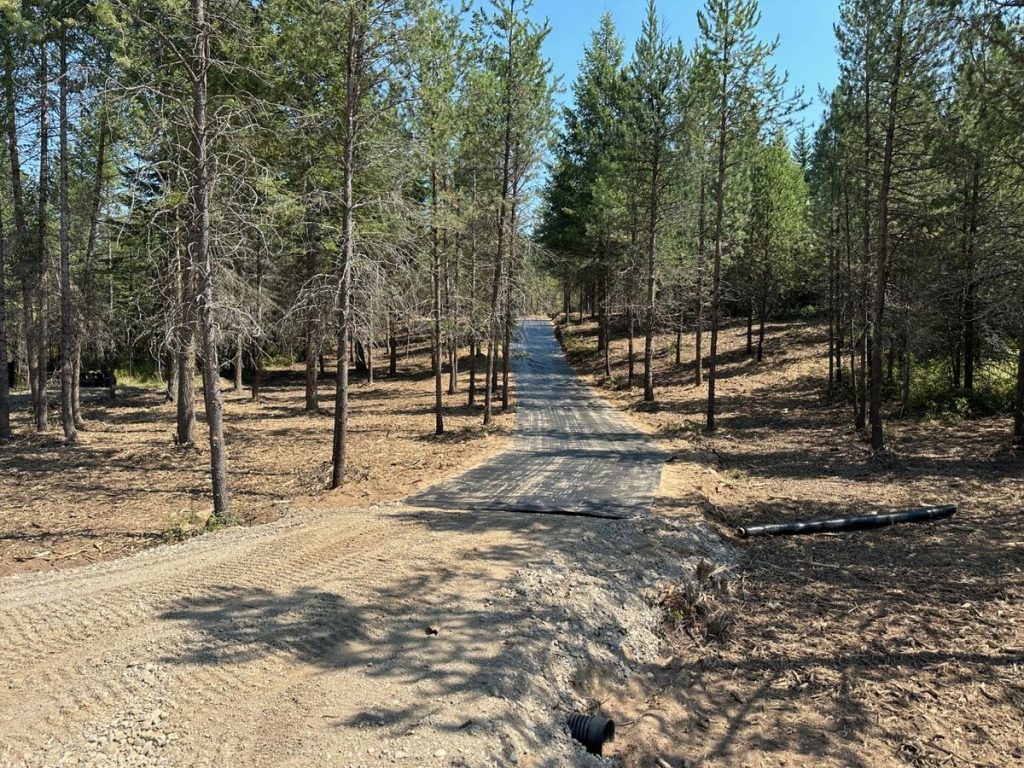
If you own raw land in Bonner, Kootenai, or Boundary County, the driveway is usually the first real piece of infrastructure that goes in. It dictates where the house sits, how fire trucks reach the building, whether you get insurance, and whether your property holds value when you sell.
Most of the driveway calls we get at Premier Land Service follow a familiar pattern: someone bought 5 to 20 acres, they have a vague trail in from the county road, and now they’re trying to figure out what it’ll actually take to make it a legal, usable, year-round driveway.
This post walks through what we see on the ground in North Idaho — material options, real cost ranges, permit triggers, and the mistakes that turn a $15,000 driveway into a $40,000 one.
What kind of driveway are you actually building
Before any numbers, you need to know which category you’re in. The standards and costs are very different.
Short residential approach (under 150 feet). Single home, gravel surface, basic culvert at the road. This is the cheapest scenario.
Long private driveway (150 to 500 feet). Once you cross 150 feet, fire access rules kick in. You need a turnaround for fire apparatus, a minimum 12-foot driving surface, and the grade matters. Selkirk Fire (the fire district covering Sagle and most of south Bonner County) enforces this under the Idaho Fire Code.
Shared or private road (over 500 feet, or serving multiple parcels). Now you’re effectively building a private road. Width goes up to 20 feet, base depth goes up, and the engineering matters because you’re carrying real traffic loads.
Most of our jobs in Sagle and Sandpoint fall into the middle category — 200 to 800 feet of driveway from a county road back to a building site.
North Idaho permit and code reality
This is where people get blindsided. There’s no single “driveway permit” — you may need three different sign-offs depending on where the driveway connects.
Approach permit from the road authority. If you’re connecting to a county road, you need an approach permit from Bonner County Road and Bridge (or the equivalent in Kootenai or Boundary County). If it’s a state highway, it’s an Idaho Transportation Department approach permit. These are typically $50 to $150 in permit fees but they dictate culvert size, sight distance, and approach geometry.
Fire code compliance. Selkirk Fire’s standards require a minimum 12-foot driving surface for residential driveways, 13’6″ of vertical clearance (trim those overhanging branches), and turnarounds for any driveway over 150 feet. Grade cannot exceed 10 percent without a variance. Bridges and culverts must support fire apparatus loads.
Bonner County Planning and Zoning. If the driveway is part of a building permit application, P&Z will check that the access meets fire code before they release a building permit. Skipping the driveway plan up front is one of the most common reasons we see building permits get hung up.
The 10 percent grade limit catches a lot of people. Properties around Sagle, Cocolalla, and the Selle Valley often have steep approaches off the highway. A 12 or 15 percent shortcut might feel fine in your truck, but it won’t pass fire code and you’ll be redoing it.
Material options and what they actually cost
We build almost exclusively gravel driveways in North Idaho because they handle the freeze-thaw cycle better than asphalt for the cost. Concrete is rare outside of the apron at the road. Here’s what each option runs:
3/4-inch minus crushed gravel (our standard top course). This is the workhorse surface for North Idaho driveways. It compacts hard, sheds water, and holds up to plowing. Locally we’re paying roughly $20 to $30 per ton delivered depending on the pit and how far we have to haul.
Pit run base (3-inch minus or 6-inch minus). Goes underneath the crushed top. Cheaper per ton — $15 to $20 delivered — and provides the structural depth for the driveway to hold up under weight without rutting. For new driveways longer than 150 feet, our standard section is 8 inches of pit run base under 4 inches of 3/4-minus cap.
Asphalt paving. Realistic for short approaches and aprons, but a fully paved 500-foot driveway in North Idaho is rare. Pavement cracks badly with our frost cycles unless the base is engineered properly, which doubles the cost.
Concrete. Almost never used except for short aprons or steep sections where gravel won’t stay put.
Real cost ranges for North Idaho driveways
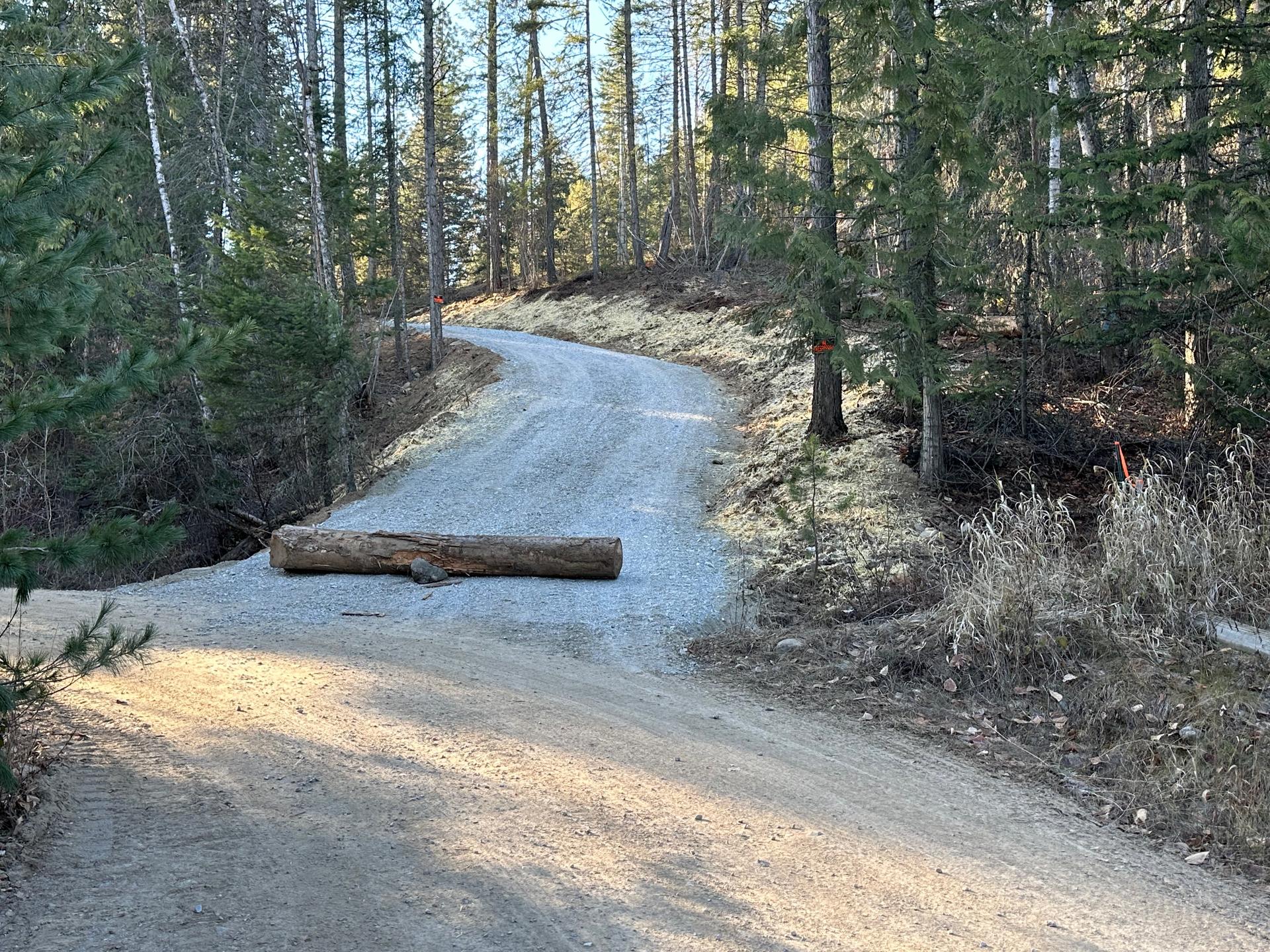
These are 2026 numbers based on what we’re actually quoting in Bonner County. Costs go up significantly for steep, rocky, or wet sites.
| Driveway scenario | Typical cost | What’s included |
|---|---|---|
| Short flat approach, 100 ft, gravel | $2,500 – $5,000 | Strip topsoil, install 18″ culvert, lay 6″ gravel, grade |
| Standard residential, 300 ft, gravel | $8,000 – $18,000 | Clearing, base prep, pit run + crushed top, culverts, drainage |
| Long driveway with turnaround, 500–800 ft | $20,000 – $45,000 | Clearing, full base, multiple culverts, turnaround, ditching |
| Engineered private road, 1,000 ft+ | $50,000 – $150,000+ | Cut/fill, retaining, full engineered section, drainage, hammerhead or cul-de-sac |
The single biggest cost variable is earthwork. A driveway across a flat hayfield is one number. A driveway with 200 feet of cut on a sidehill, with a wet seasonal swale that needs a culvert and rock armoring, is a completely different number.
Where the cost actually goes
When Joey or a project manager from Premier Land Service walks your property to bid a driveway, here’s what we’re pricing out:
Clearing and grubbing. Trees come down, stumps come out, organic topsoil gets stripped. For a 500-foot driveway 14 feet wide, that’s a substantial pile of material to move.
Cut and fill. Getting the grade right. On a flat site this is minimal. On rolling or sloped ground, this is often the biggest line item — moving thousands of yards of dirt to keep the driveway under 10 percent and to shed water properly.
Culverts and crossings. Idaho transportation standards require a minimum 12-inch diameter culvert for driveways under 70 feet long, and 18-inch or larger for longer crossings or where significant water flow is expected. A driveway across a seasonal creek can easily need a 24-inch or 36-inch pipe with rock armoring on both ends.
Base material and trucking. Driveway base is mostly trucking. The rock itself is a fraction of the delivered cost. Sites far from a pit (Boundary County, west side of Bonner County) cost noticeably more because of haul time.
Geotextile fabric. For wet or soft sites, woven geotextile fabric under the base layer is one of the cheapest insurance policies in the industry. Roughly $0.30 to $0.60 per square foot, and it keeps the base from punching down into mud.
Compaction. Properly compacted base is the difference between a driveway that lasts 20 years and one that rutts out in two seasons. We compact in lifts — base goes in one layer at a time, gets rolled, then the next layer.
Common mistakes we see
Skipping the culvert. A new driveway with no culvert at the road creates a dam. The first heavy rain washes the approach out, and the county sends a letter.
Building too narrow. A 10-foot wide driveway feels generous on day one. When the first truck delivering lumber tries to back in, you discover why fire code requires 12 feet minimum.
Wrong material order. Putting crushed rock straight on raw dirt without a base layer or fabric. The crushed rock disappears into the mud within months.
Ignoring drainage. A driveway is also a water channel whether you designed it to be or not. Roadside ditches, cross-culverts on long runs, and outslope on curves are not optional — they’re what keeps the driveway from washing out every spring.
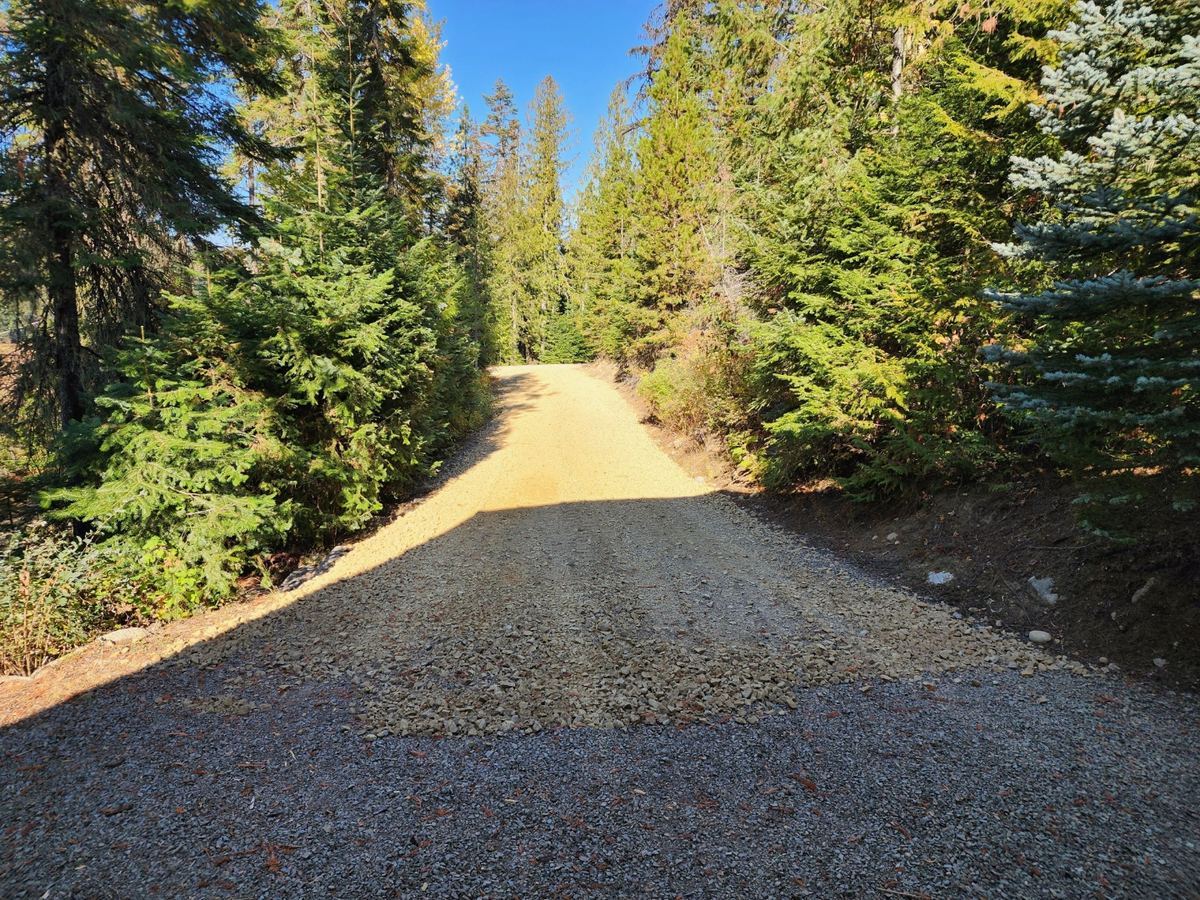
Building flat across. A driveway needs a crown — the center is built slightly higher than the shoulders so water sheds to the ditches instead of pooling in the wheel tracks. We build to roughly a 2 percent crown-to-shoulder slope. It’s invisible to the eye when you’re standing on it, but it’s the single biggest factor in how long the driving surface lasts before it potholes or washboards.
Building before you’ve sited the house. Putting in the driveway before final building location is set often means re-routing later. Drive a trail in first, walk the property in different weather, then commit to the final driveway.
When we recommend doing this work in summer
Summer (July, August, first part of September) is generally the optimal window for driveway construction in North Idaho:
- Ground is dry and compacts properly
- Less chance of weather delays
- Heavy equipment travels cleaner without rutting your finished sections
- Concrete and asphalt suppliers are running normal schedules
- Permit timelines are more predictable than during the spring rush
We try to keep our summer schedule focused on excavation work — driveways, building pad prep, septic systems, grading and drainage — because the conditions are right and the work goes in clean.
How Premier Land Service approaches a driveway job
Most of our driveway jobs start with a site walk. Joey or a project manager from Premier Land Service comes out, looks at where you want the driveway, walks the route with you, and flags the real cost drivers — slope, soil, drainage, culverts, clearing.
From there we put together a written estimate that breaks out the work into actual line items, not a single mystery number. You see what you’re paying for: clearing, earthwork, culverts, base, top course, fabric, compaction.
We’re based in Sagle and work across Bonner County, Kootenai County, and Boundary County. We’re not the cheapest crew you’ll find, but our work passes inspection the first time and the driveways we build will still be holding up a decade later.
Ready to talk about your driveway
If you’re planning a driveway or private road in North Idaho, the best time to start the conversation is before you finalize the building site. We can usually walk a property within a week and have a written estimate back to you within a few days after that.
Call 208-603-4777 or email info@premierlandservice.com to set up a site visit. Tell us where the property is, roughly how long the driveway needs to be, and what stage of planning you’re in. We’ll take it from there.
Related reading on this site: road building services, excavation in North Idaho, and grading and drainage. For comparison content, see our recent posts on forestry mulching costs and forestry mulching vs land clearing.