

Forestry Mulching in Priest River, Idaho
Pend Oreille River corridor clearing, forest service road fuel breaks, timber stand work, and defensible space for Priest River and Oldtown properties in Bonner County. Call 208-603-4777.
Forestry mulching along the Pend Oreille River corridor
Priest River is a timber-country community in Bonner County at the confluence of the Priest and Pend Oreille Rivers. The area served includes Priest River proper, Oldtown, Albeni Falls, and Lamb Creek — a corridor of mixed private timber, rural residential, and river-access properties that sit inside one of North Idaho’s more complex fire interface environments. The Pend Oreille River and its floodplain, combined with dense Idaho white pine and mixed conifer stands, create both the landscape character and the fuel-load conditions that define land management in this area. Priest Lake is in the vicinity but is not the primary reference point for this community.
Premier Land Service is based in Sagle, Idaho, approximately 25 minutes east of Priest River on U.S. 2. That makes us a local crew for Priest River-area work — not a contractor hauling equipment from Coeur d’Alene or Spokane. Owner Joey Few and a five-person insured crew bring FAE mulching heads, tracked excavators, and the Takeuchi TL12 to forest service road access country without a long equipment haul. We work steep timber-country terrain, remote parcels with marginal access roads, and river corridor lots with shoreline buffer considerations.
For forestry mulching, fuel breaks, or lot clearing in the Priest River area, request a free estimate or call 208-603-4777.
What we do in Priest River
Forest service road access fuel breaks
Private parcels accessed via forest service roads in the Priest River and Lamb Creek corridors carry elevated fire risk because fuel loads on adjacent timber ground are often unmanaged. We cut fuel breaks along private property access routes — typically 30 to 60 feet wide along the road corridor — that interrupt surface-fire spread from surrounding timber. Mulching leaves the cut material as ground-level cover rather than a slash pile, which eliminates one ignition source while reducing another.
Lot clearing and understory removal
Priest River-area lots with dense mixed conifer understory — alder, vine maple, brush, and conifer regrowth — are cleared with FAE drum masticators on tracked equipment. Material is ground in place and left as mulch cover. This is faster, cleaner, and significantly less expensive than a chainsaw-and-burn crew on ground this dense.
Defensible space and fire-fuel reduction
Structures in the Priest River and Oldtown areas sit in the wildland-urban interface with direct exposure to the timber stands that dominate the landscape. We establish defensible space buffers — 30-foot immediate zone clear of woody fuels, 30-to-100-foot reduced-fuel zone with ladder fuels removed and canopy gaps introduced — and create fuel breaks along driveways and property boundaries. Work is coordinated with Idaho Department of Lands guidelines and Bonner County fire authority recommendations.
Pend Oreille River corridor lot clearing
River corridor lots in the Priest River and Albeni Falls areas are often densely vegetated and have varying terrain from flat bottomland to moderate benches above the river. We work these lots with attention to the riparian buffer setback requirements that apply to Pend Oreille River frontage. Clearing near the river is planned to maintain bank stability and stay within permit requirements.
Lamb Creek timber stand work
Private timber parcels in the Lamb Creek drainage require periodic understory management to maintain stand health, reduce fuel loads, and improve access. Mulching the understory without disturbing the merchantable canopy is a primary application. We work to the canopy drip line without root damage to standing timber.
Brush clearing and brushing
Alder, vine maple, brush cherry, and snowberry colonize disturbed Priest River-area ground aggressively. Mechanical brushing with an FAE head eliminates the brush faster than hand-clearing and removes the root crown more completely, slowing regrowth. The mulched material breaks down within one to two growing seasons.
Trail and access cutting
Forest service road access properties in the Priest River area frequently need trail and access corridor maintenance. A mulcher clears a passable trail in a single machine pass through terrain that would require days of chainsaw work. We cut trails, skid roads, and property-line corridors to the width and specification you need.
Fence-line clearing
Encroaching brush on fence lines in the Priest River and Oldtown rural areas is brushed cleanly. We work along fences without wire or post damage and leave a clear corridor.
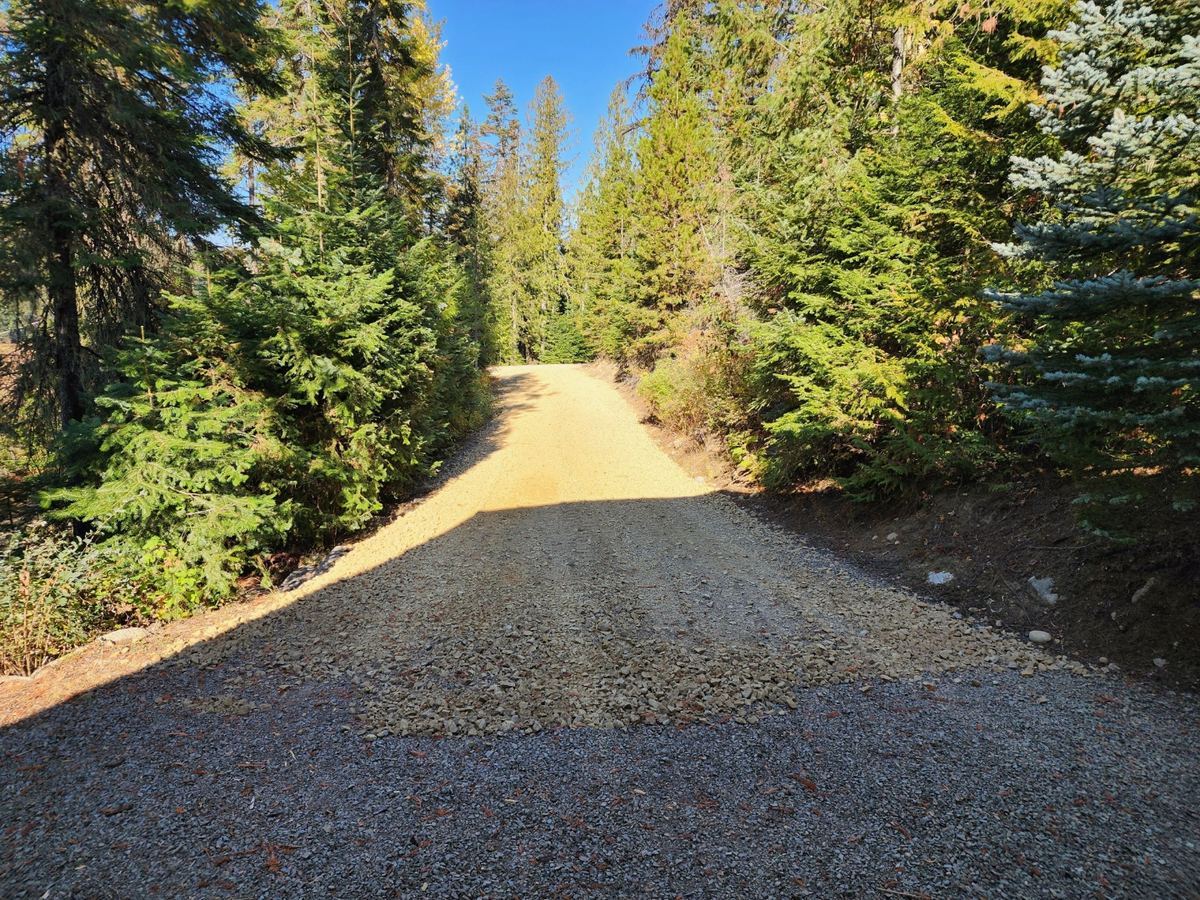
Recent work near Priest River — private access road build
Priest River-specific conditions — terrain, soil, and fire risk
Soils: Bonner County soils in the Priest River area include Pend Oreille silt loam and gravelly loam on upland sites, with heavier riparian soils along the river corridors. The Priest River drainage carries soils with significant organic content in lowland areas — these can be soft and poorly-bearing for heavy equipment in wet conditions. We assess ground conditions before mobilizing heavy equipment on river-corridor parcels.
Terrain: The Priest River area ranges from flat river bottomland at Albeni Falls to moderate and steep timbered slopes on the benches above the Pend Oreille and Priest River drainages. Forest service road access parcels are often remote with single-track access roads that limit equipment size. We assess road capacity and width before hauling tracked equipment in.
Fire risk: The Priest River corridor sits in an elevated wildfire-risk zone. Dense mixed-conifer stands with accumulated deadfall, logging slash, and brush understory present significant fuel loads. The combination of dry east-wind events in summer and the presence of timber-country access roads that can serve as ignition corridors makes fuel-break maintenance a priority for private landowners. Idaho Department of Lands is the primary regulatory contact for fire management in this area.
Riparian buffers: The Pend Oreille River is subject to Idaho DEQ and Bonner County riparian buffer requirements. Work within the setback — typically 100 feet from the ordinary high-water mark — requires review and may require a permit. We advise on what applies to your parcel before any work near the river is planned.
Forest service road access: Parcels accessible only via forest service roads may have permit requirements for commercial equipment use on the access road. We advise clients to confirm road use permit status with the Idaho Panhandle National Forests before scheduling equipment transport on FS roads.
Neighborhoods and areas we cover near Priest River
- Priest River proper — Townsite, river-corridor lots, and rural residential parcels on the highway corridor
- Oldtown — Rural residential and acreage properties; lot clearing and access work
- Albeni Falls — River-bottom and bench properties near the Albeni Falls Dam corridor; drainage-sensitive work
- Lamb Creek — Private timber and rural parcels in the Lamb Creek drainage; timber stand management and fuel reduction
We also cover surrounding Bonner County areas and western Bonner County corridors. Call 208-603-4777 if your property is not listed.
See also: Forestry mulching in Sandpoint · Forestry mulching in Sagle · Full service area
From first call to finished work — four steps.
Every Premier Land Service job in the Priest River area follows the same sequence.
1. Site walk
We drive out to your Priest River area property, walk the ground, assess timber density, access road condition, slope, and any riparian or buffer considerations. Free, no obligation.
2. Written quote
You receive a written scope with price, timeline, and equipment plan within a few business days. No verbal estimates that change on mobilization day.
3. Scheduled mobilization
We mobilize from Sagle on the confirmed start date. Joey Few is on-site or directly reachable. Access road conditions and equipment transport logistics are confirmed before mobilization.
4. Final walk and sign-off
We walk the finished work with you before invoicing. Punch-list items are addressed on-site.
Equipment on your Priest River job
- FAE mulching heads — drum masticators for all forestry mulching and brushing work
- Takeuchi TL12 track loader — primary FAE carrier; handles the slopes and ground conditions common in the Priest River timber corridor
- Kubota KX080-4 excavator — stump removal, access road work, terrain prep adjacent to mulching scopes
- Cat 306 excavator — precision work in tighter or steeper terrain
- Dump trucks — haul-off where on-site mulching is not applicable
Five-person crew, owner Joey Few on every job, insured, family-owned, based in Sagle. We haul our own equipment and do not sub the mulching scope out.
See also: Forestry mulching services · Excavation in Priest River · Pricing
Why hire a local Bonner County crew for Priest River work
Sagle to Priest River is 25 minutes. A local contractor mobilizes in the morning and is on-site without billing half a day of drive time. For remote Lamb Creek or forest service road access parcels, that efficiency matters even more — equipment that has to travel from Coeur d’Alene or Spokane adds significant cost to a half-day job.
We know the Priest River timber country. Dense mixed-conifer understory with deadfall and vine maple is not the same clearing challenge as open ponderosa brush near Sandpoint. The Lamb Creek drainage presents conditions — steep grades, narrow access, soft riparian soils — that require experience on that specific ground, not a generalist crew that rents equipment regionally.
We are insured, we use our own equipment, and Joey Few is accountable on every job. Read Google reviews from Bonner County customers or contact us to schedule a site visit.
Frequently asked questions — forestry mulching in Priest River
What does forestry mulching cost per acre near Priest River?
North Idaho clearing jobs typically run $1,800 to $3,200 per acre depending on timber density, slope, and access. Dense mixed-conifer stands with significant deadfall in the Lamb Creek drainage or on steep Pend Oreille River benches will run toward the higher end. Remote parcels with limited access may carry a mobilization premium. Free on-site estimates are provided — telephone pricing without site assessment is not accurate for timber-country work.
Can you work on parcels accessed only by forest service roads?
Yes, but we advise clients to confirm road use permit status with the Idaho Panhandle National Forests before we haul equipment on FS roads. Some forest service roads have commercial equipment restrictions or seasonal closures. We assess road width, load capacity, and surface condition during the site walk to confirm the road will support our tracked equipment without causing damage.
Can you establish a fuel break along my Priest River access road?
Yes. Fuel breaks along private access roads are a primary service in the Priest River area. We cut a corridor — typically 30 to 60 feet wide — along the access road, removing surface and ladder fuels, and mulch the material in place. The mulched corridor reduces ignition risk from a passing spark or ember cast while eliminating the slash pile that would otherwise sit on the property as a fire hazard.
Do you work near the Pend Oreille River with riparian buffer rules?
Yes, with the applicable buffer rules in place. Bonner County and Idaho DEQ govern clearing within the riparian setback — typically 100 feet from the Pend Oreille ordinary high-water mark. We review your parcel’s riparian designation before planning any work near the river and advise on what permit is required. Clearing outside the setback proceeds without a riparian permit; inside the setback requires proper review.
How do you handle steep or remote Lamb Creek parcels?
The Takeuchi TL12 handles slopes to approximately 35 percent with the FAE head. Steeper terrain gets a walk-through to assess equipment positioning and operator safety before mobilization. Remote access is assessed during the site visit — road width, surface condition, and load-bearing capacity are confirmed before we commit to bringing tracked equipment in. If the access road cannot support the equipment, we discuss alternatives.
Does mulching work in dense vine maple and alder?
Yes. Vine maple and alder are among the most common brush targets in the Priest River area, and FAE drum masticators handle them efficiently. Dense multi-stem alder thickets that would take a hand crew days to clear are processed in hours by the mulcher. The drum grinds stems and root crowns, which slows regrowth compared to cutting at grade.
Can you manage the understory of a private timber stand without damaging the merchantable trees?
Yes. We work around merchantable canopy timber — the FAE head can stop within inches of a tree you want to preserve. For timber stand understory work in the Lamb Creek drainage, we typically walk the stand with the owner first to mark the trees to be preserved, then mulch the understory in planned passes that maintain stand canopy while eliminating the surface and ladder fuel load.
When is the best time to schedule forestry mulching in the Priest River area?
Spring after ground thaw (April to June) and fall (September to October) are the primary windows for forestry mulching in Bonner County. We avoid full ground saturation in wet shoulder seasons and work around fire closure orders during peak dry months. Fuel break jobs ahead of fire season benefit from early spring scheduling. Call 208-603-4777 to check current availability.
Schedule forestry mulching in Priest River, Idaho
Premier Land Service, LLC — Sagle, Idaho · Owner-operated · Insured · Bonner County
See also: Forestry mulching · Excavation in Priest River · Road building · Service areas · Pricing